





Reasons to Avoid Purchasing Inexpensive Security Cameras
2024-05-09
When shopping for security cameras, you may notice significant price variations among models with seemingly identical specifications from different companies. However, it's crucial to understand that prices often correlate with the product's quality. As the saying goes, "You get what you pay for." Savvy shoppers should recognize why cutting corners when purchasing a security camera system is not advisable. Is saving a few hundred dollars worth sacrificing the potential savings of investing in high-quality surveillance cameras?
Here, we outline the features that industry experts at BIT-CCTV recommend considering when comparing surveillance products. These features shed light on the cost disparities between professional and inexpensive security cameras.
Here, we outline the features that industry experts at BIT-CCTV recommend considering when comparing surveillance products. These features shed light on the cost disparities between professional and inexpensive security cameras.
Quality of Image Sensors
Cheap security cameras often utilize low-quality image sensors as manufacturers seek to minimize costs. Image sensors constitute one of the most expensive components of a camera and play a pivotal role in determining video quality. Cameras equipped with subpar image sensors typically fail to deliver clear video footage.
For instance, a camera boasting 4K resolution but featuring a low-quality sensor will inevitably fall short when compared to genuine 4K security cameras. An inexpensive 4K camera priced at $100 from a budget vendor cannot match the clarity provided by a $200 4K security camera from a reputable manufacturer.
Many budget surveillance cameras produce blurry video footage in comparison to their higher-quality counterparts. It's imperative to seek out actual video samples, such as those showcased on BIT-CCTV. Avoid being swayed by stock photos that fail to demonstrate the true performance of the camera under consideration.
How to Compare Security Cameras?
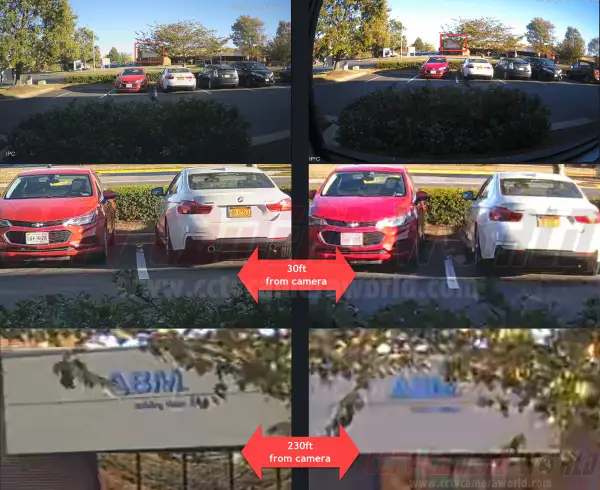
Digital zoom serves as an effective indicator of the image sensor quality within a camera, particularly concerning video capture. It's commonly utilized to enhance detail capture on faces, license plates, or vehicles. This feature magnifies a selected area of the video's field of view to reveal minute details. However, pixelation may occur when using digital zoom, depending on the camera's resolution and the sensor's quality. Low-quality image sensors tend to produce pixelated digital zoom results compared to high-quality sensors.
To demonstrate this disparity, consider the following example comparing a 4K Security Camera from BIT-CCTV to a 4K camera from an Amazon vendor. When digitally zooming to magnify license plates on cars parked 30 feet away, the difference in video clarity becomes apparent. The image captured by the cheaper camera exhibits blurriness, making it challenging to discern the license plate numbers.
To demonstrate this disparity, consider the following example comparing a 4K Security Camera from BIT-CCTV to a 4K camera from an Amazon vendor. When digitally zooming to magnify license plates on cars parked 30 feet away, the difference in video clarity becomes apparent. The image captured by the cheaper camera exhibits blurriness, making it challenging to discern the license plate numbers.
Night Time Video Quality
Security cameras equipped with built-in infrared for night vision often produce fuzzy, grainy, or unclear video footage in low-light conditions. However, high-quality cameras incorporate technology to detect and correct noisy video. Noise Reduction Technology, also known as 3DNR, employs image processing techniques to enhance video quality during nighttime surveillance.
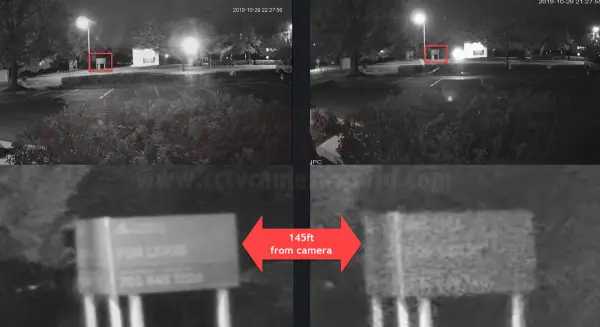
While inexpensive or "cheapo" cameras may claim to feature noise reduction, they often fail to deliver effective performance. Noise reduction plays a critical role in discerning details from a distance in black and white mode during nighttime surveillance. Without adequate noise reduction, it becomes nearly impossible to identify faces or read text on signs from a distance.
In our comparison, we observed that the "cheapo" Amazon Cameras exhibited poor image quality due to sensor limitations compounded by ineffective noise reduction. You can witness the contrast in quality below.
Encoding and Codecs - Video Compression Artifacts
Cutting costs often means insufficient investment in research and development, resulting in poorly designed software and various issues. One prominent issue with budget-friendly video products is the occurrence of video artifacts. Video encoding, necessary for video processing, is typically handled by a chip within the camera. However, low-cost chips with limited video encoding capabilities and poorly implemented encoding algorithms can lead to video artifacts. These artifacts manifest as streaks, blotches, or peculiar pixelations in the video, resembling a pixel dance, as demonstrated in the video comparison above.
Video artifacts are particularly common in the footage captured by cheap cameras, especially in higher resolution cameras like 4K. The video encoder within these cameras may struggle to handle the processing demands required for encoding 4K resolution video properly.
Artifacts hinder the identification of intruders and can render video clips useless. When video is distorted, blurred, or inadequately recorded, it becomes challenging to discern critical details. After all, what value does a camera hold if it cannot reliably record footage without video artifacts?
Durability and Longevity
Cost-cutting measures extend to the physical construction of low-cost cameras, a fact often overlooked by budget-conscious buyers. These measures encompass subpar physical design, the use of low-grade materials, inadequate weather sealing, and cheap solder.
For outdoor surveillance cameras, construction should prioritize durable materials such as aluminum or robust plastic capable of withstanding environmental elements. Attention to detail is crucial to prevent water accumulation on joints or gaps, which should be reinforced with rubber gaskets. Low-quality aluminum, lacking proper powder coating, is prone to rusting over time. Conversely, sturdy ABS plastic casings can outlast metal enclosures, as cheap plastic casings tend to crack when exposed to outdoor conditions.
Weatherproofing is another area where manufacturers may cut costs. An outdoor security camera should ideally boast an Ingress Protection (IP) rating of 66 or higher according to industry standards. However, some low-cost cameras may possess misleading IP ratings. Poorly designed cameras with inadequate water management and low-quality rubber gaskets can allow moisture ingress, leading to lens fogging or internal electronics damage.
The quality of solder used on the circuit boards inside the camera is often overlooked. Cheap cameras may utilize inferior solder material, prone to degradation or bubbling in high temperatures. This subpar soldering increases the risk of product failure, particularly in outdoor environments exposed to hot temperatures.
Warranty
When an offer seems too good to be true, it often is. Vendors advertising free warranties exceeding 2 years on surveillance camera products typically come with numerous exclusions. Product warranties typically cover manufacturing defects but often exclude misuse, tampering, modifications, incorrect voltage or power surges, lightning damage, and acts of nature. Some vendors fail to disclose these exclusions, leading to denied warranty claims.
Understanding why warranties beyond 2 years are unrealistic is crucial. New camera models are introduced every 2 years, leading to the discontinuation of older models and their associated parts inventory for repairs. If parts are unavailable for items older than 2 years, and there are no equivalent products to replace faulty items, how can warranty claims be fulfilled?
Understanding why warranties beyond 2 years are unrealistic is crucial. New camera models are introduced every 2 years, leading to the discontinuation of older models and their associated parts inventory for repairs. If parts are unavailable for items older than 2 years, and there are no equivalent products to replace faulty items, how can warranty claims be fulfilled?
Tech Support
As security products evolve into complex electronics, having reliable technical support becomes essential for effectively utilizing your purchase. Unfortunately, many cheap products come with poorly translated manuals, reflecting minimal investment by manufacturers in creating user-friendly instructional materials.
Surveillance systems often require troubleshooting due to the involvement of various components such as cabling, DVR recorders, and power supplies, all of which can impact video quality. Access to qualified and experienced technical support is vital for resolving such issues. While online sellers may prioritize price competitiveness to attract buyers, the quality of technical support often falls short. Buyers may encounter long hold times, cumbersome voicemail systems, email response delays of up to 48 hours if they're fortunate, or unhelpful and inexperienced support representatives.
Surveillance systems often require troubleshooting due to the involvement of various components such as cabling, DVR recorders, and power supplies, all of which can impact video quality. Access to qualified and experienced technical support is vital for resolving such issues. While online sellers may prioritize price competitiveness to attract buyers, the quality of technical support often falls short. Buyers may encounter long hold times, cumbersome voicemail systems, email response delays of up to 48 hours if they're fortunate, or unhelpful and inexperienced support representatives.
Take away
We trust that this guide offers valuable insights to online shoppers considering security cameras solely based on price. With numerous vendors in the security camera industry, selecting the right one depends on various factors including your budget, desired quality level, and the vendor's offerings in terms of after-sales technical support.
 How to Protect a Cctv Camera from Rain
 What's the Difference Between 4k and 1080p?
 Benefits of Surveillance Cameras in Public Places
 How to Prevent Camera Lens from Fogging at Night
 How Long Do Security Cameras Keep Footage?
 A Guide to Hiding Security Cameras
 A Complete Guide to PTZ Controller
 Best 10 Places to Put Security Cameras
 How to Power Wireless Cameras
 How to Choose the Best Security Camera Housing
 CCTV Camera Vs IP Camera: What's the Difference?
 The Top 10 CCTV Problems You Need to Fix
 Difference Between Thermal Imaging and Infrared
 How Does a Thermal Imaging Camera Work
 How Do Wireless Security Cameras Get Power
 A Guide to Reset PTZ Camera Settings
 How to Protect Outdoor Security Cameras like a Pro
 CCTV Meaning in Business Security
 What Are the Different Types of CCTV Camera Bracket?
 What Is the Difference Between Mainstream and Substream